Six social challenges for moving forward
Elvira Vega takes part in a discussion on how corporate foundations can drive social change
Others
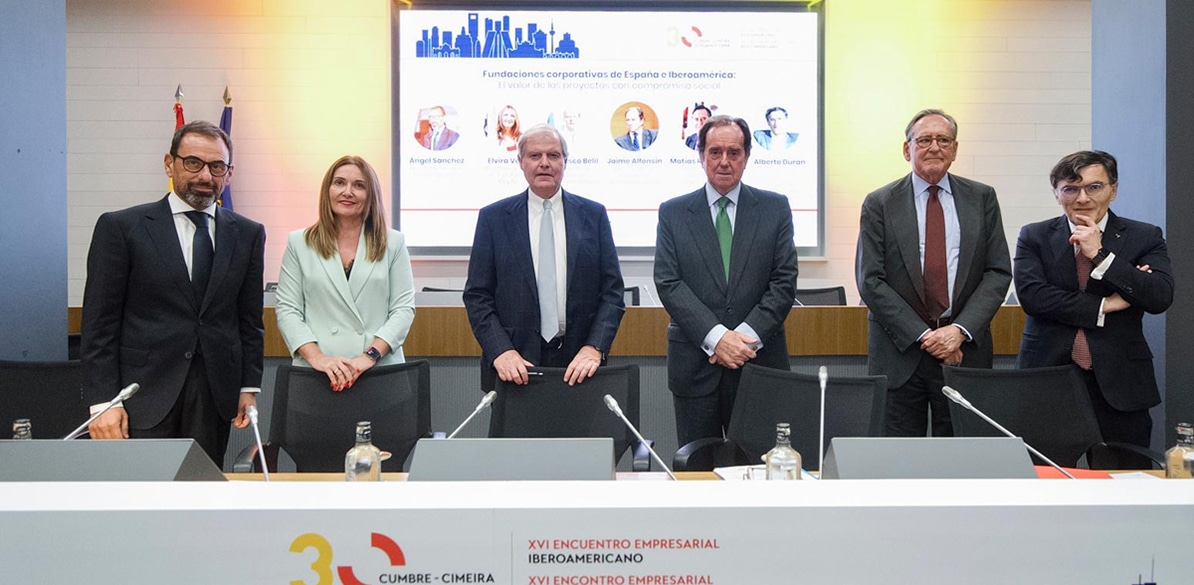
What major social challenges lie ahead? Elvira Vega, General Manager of Fundación Mapfre, addressed this question at the meeting Partnerships for impact: the role of corporate foundations in driving social change, organized by the Council of Ibero-American Business Leaders (CEIB), the Spanish Confederation of Business Organizations (CEOE), and the Fundación CEOE as part of the Road to the 30th Ibero-American Summit: Contributions from the Private Sector series and as part of the lead-up to the summit.
Elvira Vega took part in a roundtable discussion on the value of socially committed projects promoted by corporate and business foundations in Spain and Latin America, alongside representatives from Fundación Iberdrola España, Fundación Princesa de Girona, Fundación ONCE, and Santander Universidades.
Six challenges, countless opportunities to act
Child poverty is one of the most urgent challenges. More than 412 million children live in extreme poverty. “This is something we as a society must address, and business and corporate foundations have a responsibility to play their part”, Elvira Vega pointed out.
Inclusion goes so much further than employment. It also encompasses the digital, financial, social, and intergenerational spheres. Our General Manager emphasized the need to support vulnerable people “by creating real opportunities that enable them to overcome their vulnerable circumstances.” She also highlighted our employment integration programs, which achieve a placement rate of close to 70%.
An ageing population should not be seen as a problem, but as a major opportunity. Elvira Vega highlighted the value of people over 55, whose “talent, knowledge, and experience we as a society cannot afford to waste.” This is the thinking behind our Ageingnomics research center.
In terms of rural development, she stressed the need to “strengthen smaller communities in order to create opportunities for young people and care for older adults.” Because living in a rural community should not mean having fewer opportunities to build a future. That is why “we are bringing training and employment integration programs to people in these areas.” We also provide training in caregiving, to ensure that older adults receive professional support. Through the Fundación Mapfre Iberian Network, we also support third-sector organizations, helping them bolster their structures and thereby contribute to the economic, social, and cultural development of the communities in which they operate.
Education is another major priority. Elvira Vega highlighted the importance of fostering critical thinking, improving financial literacy, and preparing young people to face the risks associated with the “misuse of technology and social media.”
Finally, mental health, particularly among young people, remains a growing concern. As she reminded attendees in her remarks, “as a society we all bear this responsibility.”
These six challenges remind us that building a future with more opportunities requires us to continue working together. Public-private collaboration and partnerships with government agencies, universities, businesses, and third-sector organizations are key to expanding our capacity to drive social change and improve people’s quality of life.
The meeting brought together prominent figures from the business and institutional sectors, including Fátima Báñez, President of Fundación CEOE; Carmen Planas, Chair of CEOE’s Corporate Social Responsibility Commission; Jaume Gaytán of SEGIB; and Ignacio Niño of EY, as well as representatives from various corporate foundations.
This high-level meeting provided an opportunity to share experiences, identify common challenges, and highlight the role of corporate foundations as agents of social change in Spain and Latin America.