Touch, feel, look
We hand you a visual story on paper that addresses current issues

At the heart of every issue of our magazine, culture and social action play a leading role. The magazine also features exceptional collaborators: artists, writers, journalists, who in each issue weave a story covering the issues that interest you. The bilingual format multiplies the reading experience, since you choose the language, Spanish or English, in which you want to enjoy each page.
Large scale and carefully designed, la fundación arrives in your hands every four months. Get all the issues and collect them. You can enjoy them whenever you want.
11 results
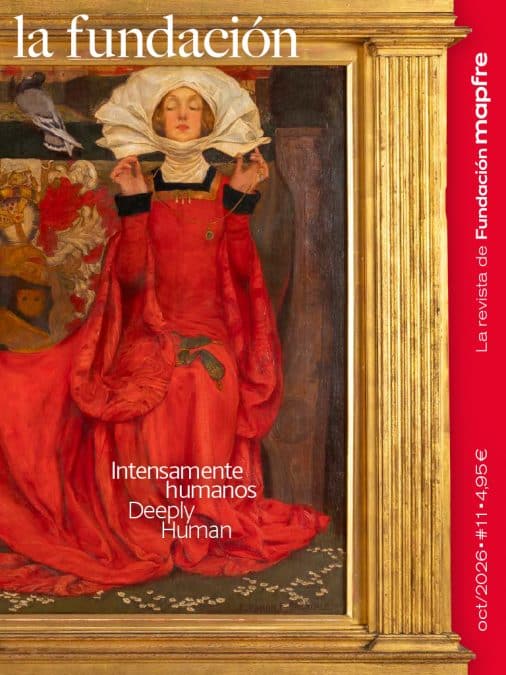
#11. Intensely Human
We open this issue with a line by Federico García Lorca: “I was born to keep my eyes open.” Attentive, and guided by his words, we begin this journey by delving into avid sensitivity with philosopher Leo Espluga, and into feelings with writer María Dueñas. In Concomitance, Paula Ortiz and Karina Sainz Borgo explore instinct and desire through film and literature.
We continue with Begoña Arana, from Asociación Betania; with Dan Pontefract, an expert in senior talent; and with Elvira Vega, General Manager of Fundación Mapfre, who shares her reflections on ageing and humanity. With regard to the adventure of being mortal, we talk with philosopher Javier Gomá, who champions slowness.
In art, we explore the legacy of Hans Prinzhorn, through the relections of Sandra Delaporte and a reading list selected by Pilar Soler Montes; we also take a closer look at the Pre-Raphaelite artists and hear Ignacio Vleming‘s memories of them. In photography, we discover the portraits of Dana Lixenberg alongside the exhibition coordinator Victoria del Val; we meet the young artists of KBr FLAMA’26; and we revisit the dialogue between poet Mario Obrero and the photographs of Facundo de Zuviría.
We also address eating disorders, while the Fundación Mapfre Awards for Social Innovation return to our pages along with the winners of the ninth edition.

#10. From the individual to the community
In this issue, in which we celebrate our most social dimension. We explore our connection with ourselves and with others alongside neuroscientist Nazareth Castellanos, and look back through time with paleontologist Juan Luis Arsuaga. In Concomitance, writer and illustrator Sara Herranz explores the negotiation between individuality and shared life, while communicator María de León Castillejo, inspired by the photograph Bolivia, the work of Rocío Aguirre, explores the idea that we are social beings.
Paula Torres of Fundación Mapfre, Andrés Conde of Save the Children Spain, Sara Giménez of Fundación Secretariado Gitano, Carmen Gayo of Action against Hunger, and Inés Temes of Fundación Telefónica discuss the impact of our actions.
Photography occupies a central place in these pages, with work by Richard Avedon, Minor White, Gloria Oyarzabal, Carlos Pérez Siquier and Alejandro Cartagena, accompanied by reflections from journalist Paloma Abad, curators Anna Wieck and Lucía de Lucas, flamenco dancer Francisco Hidalgo and writer María Sotomayor.
We also launch a series on mental health, beginning with a focus on self-harm injuries, and close with Elena Barraquer, who restores light and dignity through surgery.
Welcome to issue 10 of our magazine.

#9. Portraying the soul
In this issue, we explore different ways of understanding and representing the human soul.
In The Imprisoned Soul, writer Héctor Abad Faciolince asks what the soul is. An example of a soul expressed through music can be found in João Carlos Martins, the Brazilian pianist and conductor who received our Lifetime Achievement Award. His career and resilience are explored by Casilda Sánchez-Varela.
Photography lets us see things in a different light: Anders Zorn, analyzed by Casilda Ybarra Satrústegui; Pérez Siquier, from the perspective of Eva M. Vives Jiménez; and Helen Levitt and Walker Evans, examined by Marta D. Riezu and María José Porras Sepúlveda. Paula Ducay and Inés García, from Punzadas Sonoras, also question the boundaries between body and spirit.
This issue also addresses the mental health of young people; the dignity of the Roma people, with Sara Giménez and Noelia Cortés; and the relationship between space and well-being through Proyecto Suelo, which, according to professor Manuel Blanco, dignifies architecture.
The voice of Mara Torres and the music of Alejandro Pelayo complete this journey, which concludes with Alejandro Simón Partal inviting us to also inhabit that which remains in the shadows.

#8. Speak and listen
The common thread running through this new issue of our magazine is the complex art of understanding and being understood.
Writer Juan Gabriel Vásquez calls for the return of meaningful conversations. And in the Concomitance section, Laura Riñón and Pilar Llácer reflect on the keys to communication.
Mexican photographer Graciela Iturbide engages in a dialogue with the world, while the images of Helen Levitt, by contrast, are not looking for any response at all. Eva M. Vives, coordinator of the exhibition, invites us to discover her universe through a selection of books. In this universe of images and silences, stopping to listen is, for Violeta Dávila, the most human of gestures.
We also take a look at the work of Raimundo de Madrazo, through the eyes of writer David Uclés. And we invite readers to begin their own album of iconic images by Edward Weston, whose work is currently on display in our galleries.
Pianist and poet Alejandro Pelayo invites us to discover the power of silence as music envelops us. And, as always, in the fields of communication and health, we explore technoaddictions and the deception of miracle diets.
We speak with Luis Padilla, founder of the Asociación Manabí, and Lola Manterola of the CRIS contra el cáncer foundation. We also introduce the people behind the shortlisted projects in the Fundación Mapfre Awards for Social Innovation.

#7. Something to remember
This new issue of our magazine is a journey through our living memory, through 50 years filled with thousands of moments, people, and stories that live in our hearts.
With José Antonio Marina, a perceptive thinker and outstanding educator, we delve into the role of memory. And in the Concomitance section, Anabel Vázquez and Sara Barquinero confront us with the verbs forget and remember.
We look back at the more than 500 exhibitions that have been held in our galleries. Faced with this abundance of beauty, Noemí Oliva wonders whether it is possible to remain indifferent.
We forge memories through the work of Edward Weston, one of the featured artists in our new exhibitions. And we talk with photographer Nicholas Nixon and his wife, Bebe, who, along with her sisters, starred in the series of photographs that changed everything.
And as we remember the past, we also look to the future. We have spent five decades improving the prospects of thousands of people. Alongside us are people like Catalina Escobar, who left corporate success behind to declare war on poverty. Like Elena Huarte-Mendicoa, of Aceleradora Unoentrecienmil And like Jon Sistiaga, whose pen and voice remind us that the good truly outnumber the bad.
Carlos Gollonet, who spearheaded our photography exhibition program, takes stock of more than 500 exhibitions that have opened their doors and, together with Paula Susaeta, comments on a selection of some of the best Fundación Mapfre photography catalogs.

#6. Realities
Issue 6 of our magazine explores different dimensions of reality, from the hyperreality of André Breton to the vision of El Niño de Elche. Nuria Espert, the grande dame of Spanish theater, reflects on the need to remain true to oneself, while Juan Cruz celebrates her qualities as both an actress and a human being. In the Concomitance section, artists Nicolás Villamizar and Marina Vargas explore the limits between reality and fantasy.
The exhibition 1924, Other Surrealisms brings together the voices of the artists who constructed a different kind of Surrealism to that categorised by André Breton. Estrella de Diego, its curator, presents us with six essential readings that help us dive deeper into this universe.
In Barcelona, we present the series Bravo by Felipe Romero Beltrán, winner of our latest KBr Photo Award, while the images of José Guerrero blur the boundaries between reality and representation, prompting Javier Ortega to question whether nature really exists. In Madrid, Sakiko Nomura captures a mystery in her images that Lois Patiño attempts to decipher.
We also tell you about Moda-re, the inclusive initiative by Cáritas, and the impact of the Comunidad Mapfre-UP project in Mexico City. The philosopherPascal Bruckner reflects on the age revolution, and in our section on technoaddiction we analyze the risks posed by videogame abuse.
To round it all off, philosopher José Carlos Ruiz reflects on the deficit of reality and how much of it we need it to stay alive.

#5. In search of beauty
We are dedicating this new issue to The Search for Beauty. The poet Piedad Bonnett, in her love letter, invites us to reflect on how we perceive beauty. Sara Torres and Jacobo Bergareche share their views on this search, the former reflecting on Peggy Guggenheim and the latter on Weegee. To delve deeper into this matter, we speak to the neuroscientist Nazareth Castellanos: the researcher reveals the secrets of the brain and confirms that beauty does indeed bring happiness. Furthermore, we introduce you to the stars of the fall exhibitions – the photographer Weegee, the patron and collector Peggy Guggenheim, the art dealer Paul Durand-Ruel and the hunter of decisive moments Henri Cartier-Breson, who, as Bernard Plossu explains in his column, pursued extraordinary beauty in each and every one of his photos. Isabel Tejeda and Richard Learoyd help us understand what determines beauty and where to find it; and we gain an insight into the deep and evocative gaze on the margins of dignity and beauty of film director Paula Ortiz. Former NBA player José Manuel Calderón talks to us about inclusive sports and we discover the most outstanding safe and sustainable mobility projects recognized in our Fundación MAPFRE Social Innovation Awards. We also introduce you to a new section, Technoaddictions, which on this occasion addresses the problem of online gambling among young people; and in a final approach to rare diseases, we deal with “butterfly skin”.

#4. Utopias: looking beyond
This new issue features the work of South African photographer David Goldblatt and Chilean photographer Paz Errázuriz, who both use the camera as a tool for social criticism. Angelo Néstore and Mario Obrero share their views on the transcendence of Paz Errázuriz‘s photography today. Menchu Gutiérrez and Ángel Mateo Charris address the “utopia/dystopia” binomial; Emma Suárez, now 60 years old, talks about the present and her plans for the future; and Teresa Perales, Paralympic athlete, conveys her energy and strength. The writer Marta Sanz reflects on the reality hidden in stories and, through the tale of Ian, a child with hemiplegia, we raise awareness of rare diseases. In the pages of this fourth issue we also talk about social media, malnutrition and how receiving charity can transform us into volunteers.