Raimundo de Madrazo
SEP.19.2025 ──────── JAN.18.2026
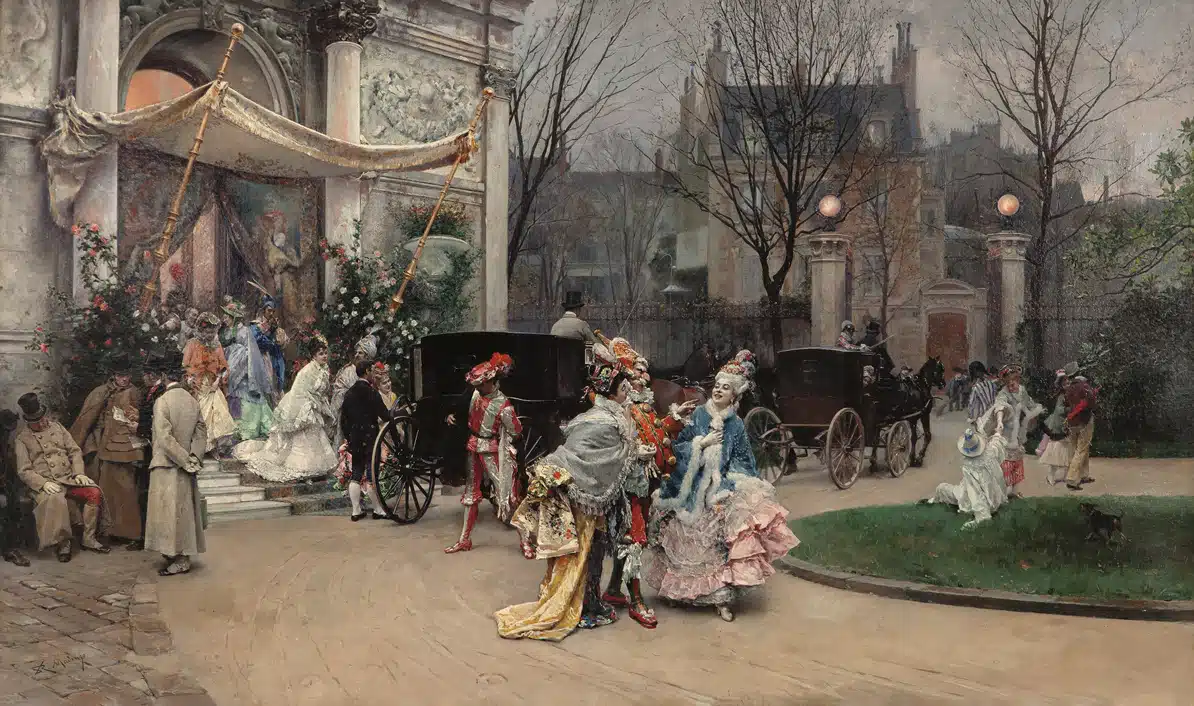
Raimundo de Madrazo y Garreta
Salida del baile de máscaras, 1878
Colección particular
Exhibition
SEP.19.2025 ── JAN.18.2026
Where
Recoletos Exhibition Hall
Paseo Recoletos 23, 28004 Madrid
At the age of 20, Raimundo de Madrazo y Garreta (1841–1920) traveled to Paris to complete his artistic training. In doing so, he followed the family tradition: his grandfather José and his father Federico de Madrazo had studied in the Parisian ateliers of Jacques-Louis David and Jean-Auguste-Dominique Ingres, respectively. In contrast to them, the third major representative of the most renowned dynasty of 19th-century Spanish painting did not return to Spain, but instead developed his entire career between Paris and the United States, where he conducted various portrait tours starting in 1897, as his role in the French art scene gradually faded.
In Paris, he initially devoted himself to genre painting, developing a body of work that commanded high prices on the international art market thanks to the meticulous detail of his brilliant interiors and his skills as a master colorist. From the mid-1870s, he progressively turned to portraiture, a genre in which he ultimately became one of the favored portraitists of the Parisian and American high society, who frequented his elegant Parisian atelier. During the 1870s and 1880s, he produced several emblematic works of this genre, masterful examples of cosmopolitan distinction and refinement.
Madrazo achieved his long-awaited official recognition at the 1878 Universal Exposition, where he presented 14 works that earned him a First-Class medal and the Knight’s Cross of the Legion of Honour.
Discredited by later artistic canons, his work has been unjustly overlooked by critics and art history. Organized in collaboration with the Meadows Museum (Dallas), this exhibition recovers, through around one hundred of his most significant works, the artistic language and oeuvre of one of the most cosmopolitan painters of his time.
Curator: Amaya Alzaga