Dan Pontefract: “Every organization is quietly accumulating an age debt. The cost will become clear when the knowledge held by its most experienced professionals disappears.”
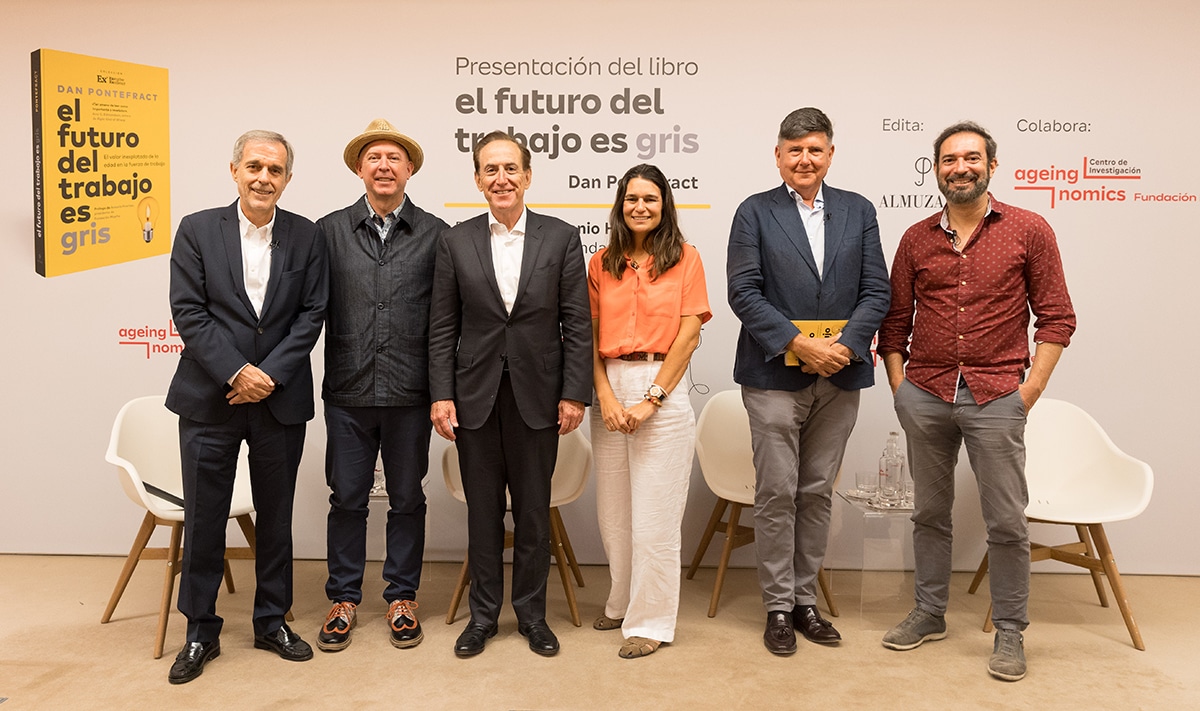
Caption for the attached photo, from left to right: Juan Fernández Palacios, director of the Ageingnomics Research Center; Dan Pontefract, author of the book and international expert in leadership and organizational culture; Antonio Huertas, president of Fundación Mapfre; Casilda Heraso, director of Ashoka Fellow Selection and New Longevity; Manuel Pimentel, writer and former Minister of Labor and Social Affairs, and Pere Estupinyá, biochemist and science communicator.
One in five working-age people in Spain is over 55, yet their employment rate continues to decline
Fundación Mapfre presents the book The Future of Work Is Grey at an event on employment, longevity, and generational diversity
- Antonio Huertas, president of Fundación Mapfre: “The greatest risk companies face isn’t an aging workforce, but failing to make use of the talent it has accumulated.”
- Manuel Pimentel, writer and former minister of Labor and Social Affairs: “The challenge is to turn senior talent into a strategic asset and generational diversity into a driver of innovation and creativity.”
- Pere Estupinyá, biochemist and science communicator: “In the future, there will be more older people, but fewer elderly people.”
- Casilda Heraso, director of Ashoka Fellow Selection and New Longevity: “The future of work is grey, but it can also be more innovative, flexible, and inclusive if we’re bold enough to design it that way.”
Falling birth rates, rising life expectancy, and the aging of the workforce are transforming the structure of employment and the way organizations manage talent, knowledge, and experience. In Spain, more than five million people in the workforce are over 55, equivalent to one in five workers, or 20% of the total. However, this group’s employment rate continues to decline, according to reports by Fundación Mapfre’s Ageingnomics Research Center. This reality is forcing companies to rethink how they can make the most of the experience offered by an increasingly long-lived workforce.
To explore this situation and its implications for companies and employees, Fundación Mapfre’s Ageingnomics Research Center held an event featuring the presentation of The Future of Work Is Grey, a book by international leadership and organizational culture expert Dan Pontefract. The Spanish edition of the book was promoted by Fundación Mapfre and published by Almuzara.
Antonio Huertas, president of Fundación Mapfre, opened the event by emphasizing the need to approach demographic change as an opportunity. “For years, we’ve examined the challenges associated with an aging population, but we now know that it also presents enormous opportunities. A longer-lived society requires new ways of understanding work, learning, and economic participation so we can harness the talent and experience of every generation,” he said.
Huertas also warned that this transformation coincides with another major revolution: technological change. “AI can help us become more efficient and improve processes, but it can’t replace the value of accumulated experience. Dispensing with senior talent would mean giving up an essential part of the knowledge organizations need to navigate increasingly complex environments.”
The future of work is grey: turning experience into a competitive advantage
The event featured Dan Pontefract, author of The Future of Work Is Grey. The book examines the impact demographic aging will have on employment, productivity, and leadership models over the coming decades. It will be available in bookstores in September.
During his presentation, Pontefract explained that companies and institutions continue to operate according to structures designed for younger societies, even though demographic conditions are changing rapidly. As a result, organizations will have to manage increasingly long-lived and generationally diverse workforces. Pontefract warns that the world is facing a genuine “demographic tidal wave,” a structural shift that will affect employment, productivity, innovation, and economic systems. As he explains, society will move from a bell-shaped demographic structure—with many young people and relatively few older people—to a bulb-shaped structure. Its base will become increasingly narrow as birth rates fall, while its upper section will widen as longevity increases.
He argues that the greatest risk for organizations isn’t aging itself, but ignoring it. He calls this phenomenon “age debt,” a concept describing the risks associated with losing knowledge and experience when employees retire without adequately transferring what they know and when organizations lack intergenerational talent-management strategies. According to Pontefract, this lack of planning can result in lower productivity, higher labor costs, difficulties attracting and retaining talent, the loss of critical knowledge, and a reduced capacity for innovation. “Every organization is quietly accumulating an age debt. The bill will come due when its most experienced professionals leave the company, taking with them knowledge that no one bothered to write down,” he said.
To address this challenge, the book proposes harnessing what Pontefract calls the “experience dividend”: the value organizations generate when they treat senior talent as a strategic asset and encourage professionals of different ages to work together. In Pontefract’s words, “It’s time to stop treating experience as a cost to be managed and start viewing it as a dividend worth investing in.”
He also argues that “the most competitive organizations will be those capable of encouraging collaboration across generations, combating ageism, and building workplace cultures in which experience, innovation, and continuous learning coexist naturally.” He adds that it’s important to support longer and more flexible careers, facilitate new phased-retirement models, promote continuous learning throughout people’s working lives, and develop structured mentoring and intergenerational knowledge-transfer programs. He also advocates new leadership styles capable of managing increasingly generationally diverse teams, as well as employment policies adapted to greater longevity.
Ultimately, he argues that the future of employment won’t belong to any single generation, but to all of them, and that success will depend on the ability of younger and more experienced professionals to work together: “The goal isn’t to favor one group over another, but to find the common ground where they can do their best work together.”
Managing talent in a longer-lived society
The event also included a panel discussion moderated by Juan Fernández Palacios, director of Fundación Mapfre’s Ageingnomics Research Center. Panelists included Manuel Pimentel, former minister of Labor and Social Affairs, writer, and editor at Almuzara Libros; Pere Estupinyá, biochemist and science communicator; and Casilda Heraso, director of Ashoka Fellow Selection and New Longevity.
“Given today’s demographic situation, companies and employees face a major challenge: turning senior talent into an asset and generational diversity into a driver of innovation and creativity,” Manuel Pimentel said during the discussion. Speaking on behalf of the publisher, he also emphasized that Dan Pontefract’s book is “an invitation to rethink workplace culture and talent models so they can adapt to this new reality. It addresses such important issues as new phased-retirement models, continuous learning throughout people’s working lives, structured mentoring and intergenerational knowledge-transfer programs, and new leadership styles, among many other major topics.”
Pere Estupinyá noted that longevity is one of the greatest social and cultural transformations of our time and requires society to reconsider many of the stereotypes associated with aging. “The new longevity is revolutionary not because we’re living longer, but because we’re living those additional years in an entirely new way,” he said. He also explained that today’s generations are entering this stage of life with greater autonomy, activity, and confidence, accelerating the decline in internalized ageism. He said that society is undergoing a profound redefinition of what it means to grow older: “In the future, there will be more older people, but fewer elderly people.”
Finally, Casilda Heraso emphasized that the challenge isn’t simply to extend people’s careers, but to recognize older people as active agents of change who can continue contributing experience, knowledge, and leadership. “The future of work isn’t just about extending working lives. It’s about creating more flexible ways for people to participate, learn, start businesses, and contribute throughout their lives,” she said. She also stressed the need to promote more inclusive models that combat ageism and create new opportunities for economic and social participation. “If Spain aspires to be one of the world’s longest-lived countries, it should also aspire to be one of the countries that makes the best use of the potential created by that longevity.”
The experts agreed that workplaces must adapt to a new demographic reality in which experience, continuous learning, and collaboration across generations will be key to competitiveness and social cohesion. “Population aging is no longer just a social challenge. It’s also a decisive factor in organizational competitiveness and the sustainability of the labor market over the coming decades,” Juan Fernández Palacios concluded.
Para más información y gestión de entrevistas:
Alejandra Fernández Martínez
690.04.91.12
alejandra@fundacionmapfre.org