
Travelling exhibitions
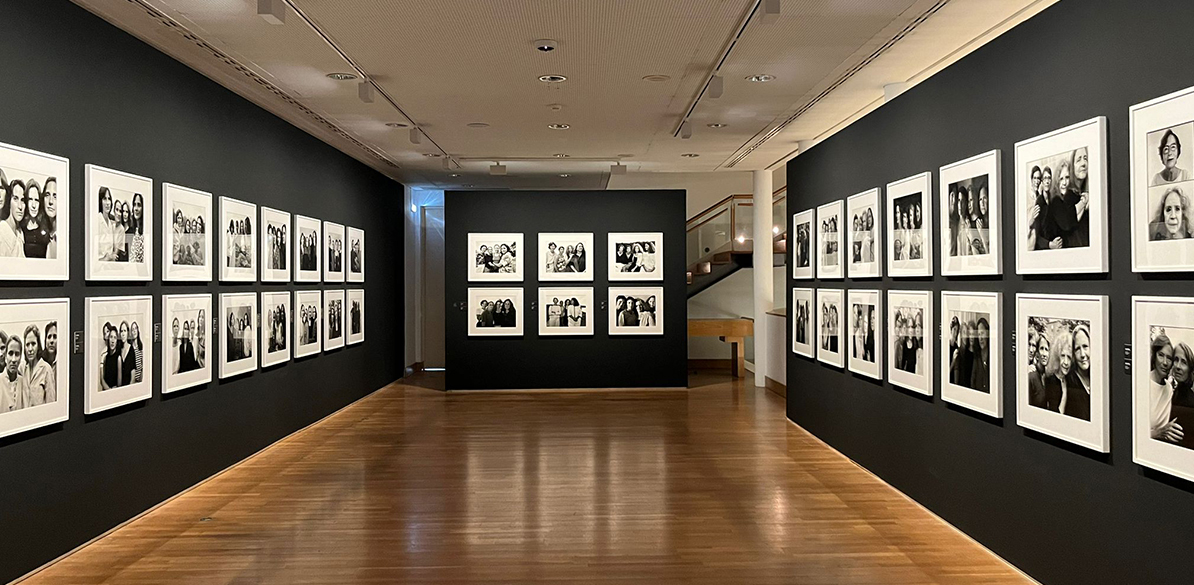
Our exhibition rooms in Madrid and Barcelona are not the only places you can enjoy our photography, drawing, painting and sculpture exhibitions. Once they have been presented in Spain, our idea is that they should be shared far and wide. We want to reach the rest of the world!
Thus the retrospective on Walker Evans headed to Sao Paulo, Stephen Shore to Berlin, Vanessa Winship to Las Palmas de Gran Canaria, the selection of drawings in our collection Hand with Pencil to El Salvador and From Divisionism to Futurism to the Museum of Modern and Contemporary Art of Trento e Rovereto, in Italy.
Part of our program travels to museums and cultural institutions in Europe, North America and Latin America. We want to take art to every corner of the globe. And we hope it reaches you too.
87 exhibitions
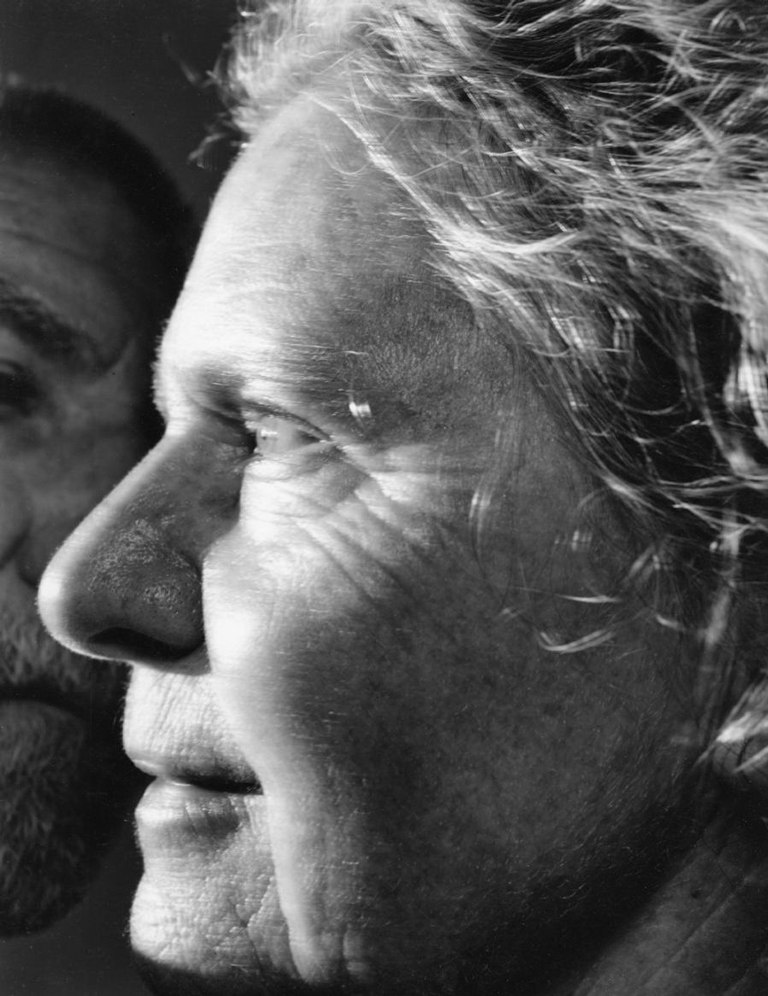
Bebe, Savignac de Miremont, 2011
Gelatin silver prints, contact
© Nicholas Nixon.
Fundación MAPFRE Collections.
Nicholas Nixon. The Brown Sisters
–
Intimacy. The passage of time. Vulnerability.
When in 1974 Nicholas Nixon took a photograph of his wife Bebe and his sisters-in-law Mimi, Laurie and Heather, he did not know that this would be the start of the series known today as The Brown Sisters, one of the most compelling investigations of portraiture and time in contemporary photography. Currently, this work in progress, which expands each year with a new image, is composed of 45 images created in silver gelatin.
The series exudes a familiar air that transports us back to past moments and emotions. Its strength lies in its repetition (the four women are always portrayed in the same order, looking at the lens) and in the change of rhythm within that repetition, which has been proceeding, year after year, since 1975. Each of the images takes on body and meaning in relation to the others and, as a whole, contemplated as a series, they become instants of equilibrium within the incessant rhythm of transformation.
Nicholas Nixon (Detroit, Michigan, 1947) occupies an outstanding and singular place in the history of recent photography, combining his personal activity as a photographer with his work as a professor of this discipline at the Massachusetts College of Art in Boston up until 2017. His work, which employs a very refined technique and careful composition, draws us into the daily reality of the people he portrays. His closeness and humanity make the viewer participate and identify with the emotions that underlie his images.
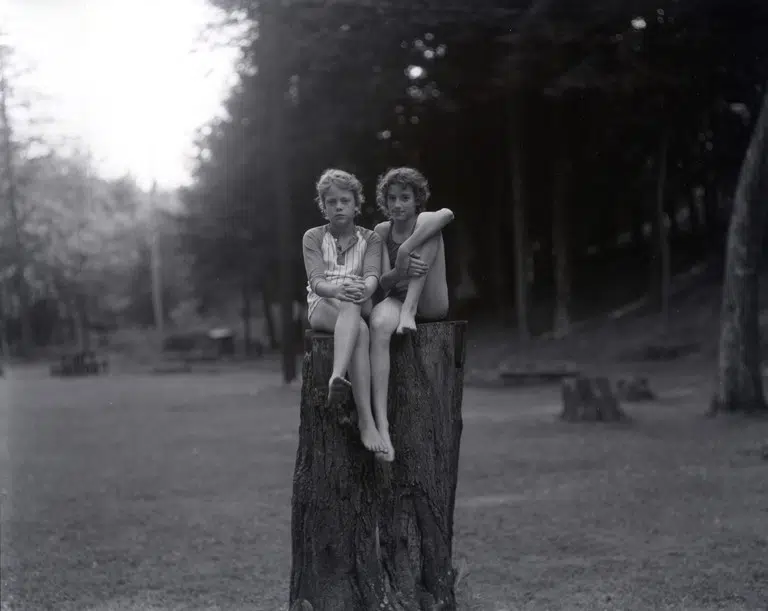
Judith Joy Ross
Untitled, Eurana Park, Weatherly, Pensilvania, 1982
© Judith Joy Ross, courtesy Galerie Thomas Zander, Cologne
Judith Joy Ross
– 18
Comprehension. Personal impulse. Capturing the commonplace.
Judith Joy Ross photographed people as a way of understanding the emotional world of those around her. Today, she is considered one of the most influential portrait artists. It is a genre through which she is able to capture the present, past and future of the individuals who step in front of her camera.
Her portraits are often framed in the context of a previously chosen subject: Eurana Park; visitors to the Vietnam War Memorial; members of Congress during the Iran-Contra (Irangate) scandal; Hazleton school children; and specific places such as Easton, Pennsylvania, where she was born, raised, and still lives today.
Bill Brandt
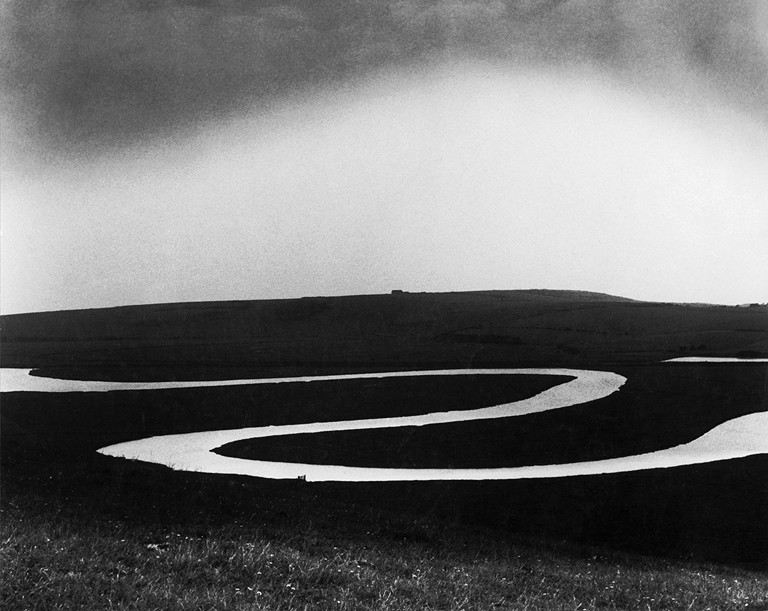
Río Cuckmere, 1963
Private Collection. Courtesy of the Bill Brandt Archive and the Edwynn Houk Gallery.
© Bill Brandt / Bill Brandt Archive Ltd
Bill Brandt
– 18
Surrealism. Portraiture. The sinister.
Bill Brandt’s conception of photographic language as a powerful means of contemplating and understanding reality, but always from a primacy of aesthetic considerations over documentary aspects, makes him one of the founders of modern photography.
His work expresses a permanent attraction to everything strange, to everything that causes attraction and strangeness and provokes unease. Unheimlich, which is usually translated as “the strange”, “the sinister”, “that which produces uneasiness”, is one of the characteristic features that we find throughout his career.
Almost all of his images, both those of a more social nature from before the war and those from his subsequent more “artistic” stage, are strongly poetic and maintain that halo of strangeness and characteristic mystery where, as in his life, reality and fiction are always mixed.
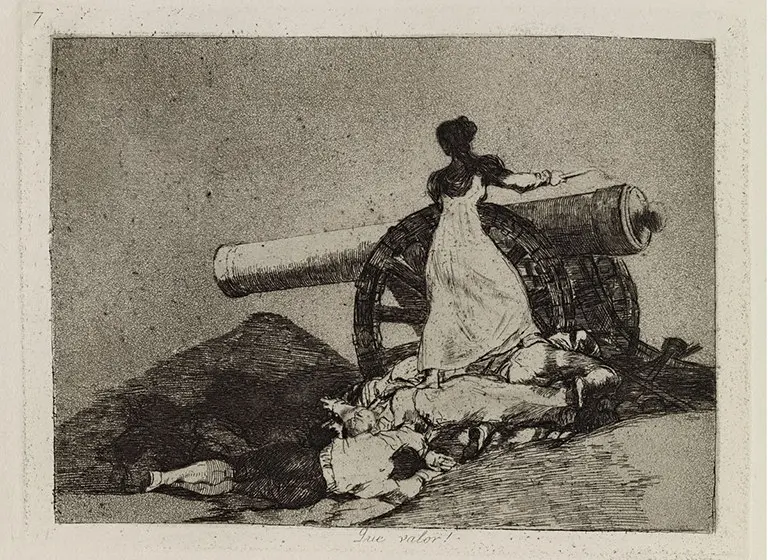
Francisco de Goya y Lucientes
What courage!
Etchings, aquatint, drypoint, burin and burnisher, 158 x 209 mm
Fundación MAPFRE collections
Francisco de Goya y Lucientes. The disasters of war
– 03
Museo de Bellas Artes de Castellón
Clarity. Movement. Desolation.
The violence that Goya witnessed during the Spanish War of Independence (1808-1814) prompted him to make drawings, sketches and prints, through which he could express his pain and anguish at the events to which he was both witness and victim.
The series Desastres de la Guerra (Disasters of War) is understood as a reflection on the consequences of the events during Ferdinand’s absolutism.
Goya’s gaze is one of clarity, but it also reveals the cruelty, misery, hunger, torture and death.
The exhibition features 9 prints of the eighty that make up the fourth edition of this series of engravings by Francisco de Goya y Lucientes, Los Desastres de la Guerra (The Disasters of War), which were acquired in 2013 by Fundación MAPFRE.
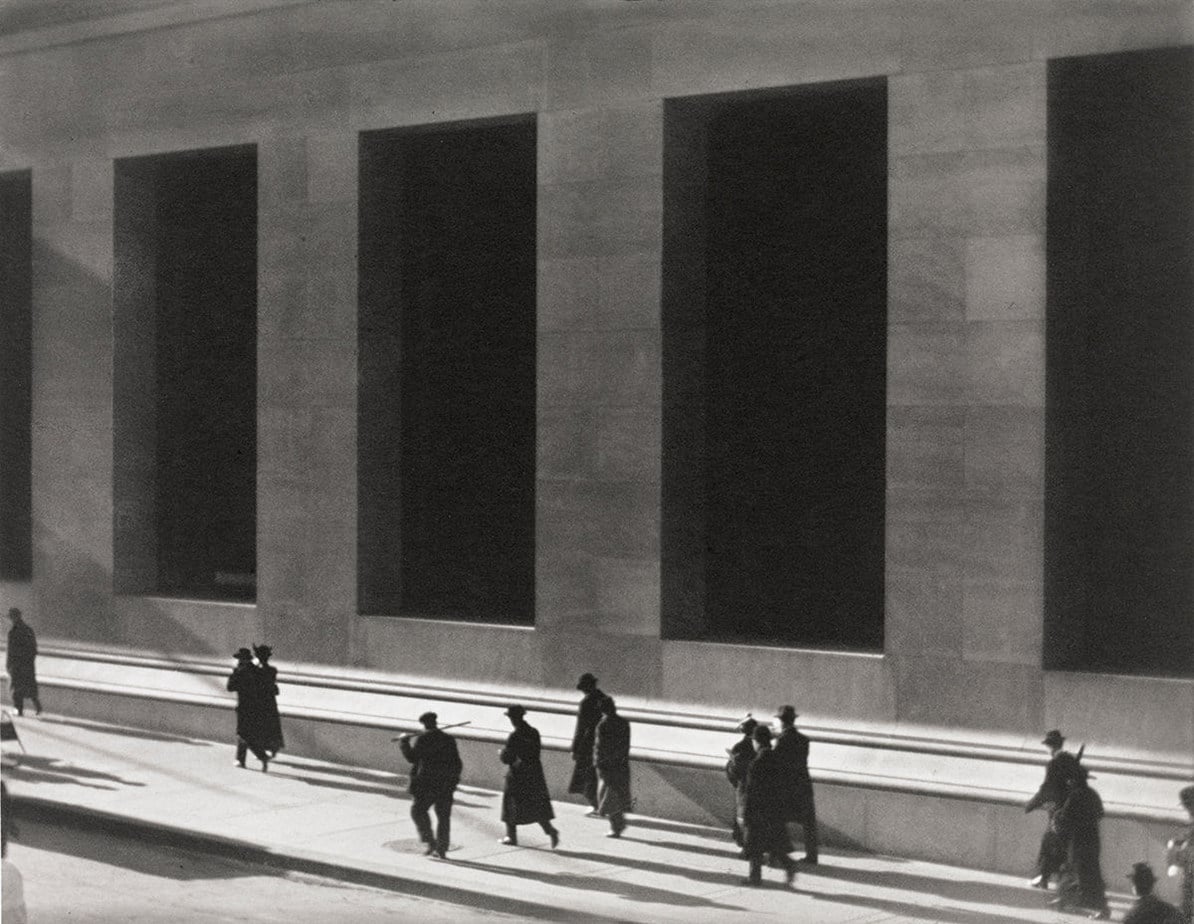
Paul Strand
Wall Street, New York, 1915
Fundación MAPFRE Collections
© Aperture Foundation Inc., Paul Strand Archive
Paul Strand. Direct beauty. Photographs from the Fundación MAPFRE Collections
– 06
Museo Carmen Thyssen de Málaga
Commitment. Nuance. Movement.
Paul Strand is one of the most important photographers of the 20th century. Armed with his camera, he explored photography’s potential as an instrument for overcoming mere human vision through intimate and detailed portraits, and by capturing nuance in mechanical and natural forms. His photographs also project his ethical and social commitment.
Throughout his career his interests focused on the city and movement, as well as on everyday objects that he photographed using a small diaphragm in his camera. This way of confronting the medium, which transformed a good part of his compositions into abstractions, led him to create a type of art that transcended his time and made him one of the fathers of what is currently known as straight photography or direct photography.
This exhibition showcases the artist’s images from the Fundación MAPFRE Collections.
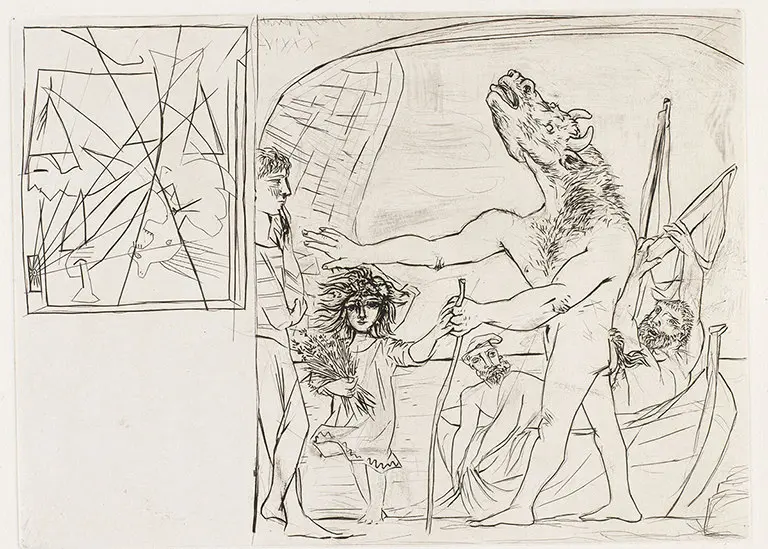
Pablo Picasso
Blind minotaur led by a little girl, I,, I, 22.09.1934
© Pablo Picasso: Estate of Pablo Picasso / VEGAP, Madrid
Picasso. Vollard Suite
– 13
Het Noordbrabants Museum, Then Bosch, The Netherlands
The sculptor’s workshop. Minotaur. Rembrandt.
The Vollard Suite is one of the greatest works of 20th century art. The best Picasso is present in these plates, the one who knows how to endow his creations with his own recognizable style that transcends the world of specialists and can be identified by the general public.
The work harbors a compendium of recurring themes for Picasso —love, violence, the difficulties of artistic creation— organized in a crescendo that leads to iconography very close to that of Guernica.
The exhibition features one of the few complete series in existence, belonging to the Fundación MAPFRE Collections.
Paul Strand
Wall Street, New York, 1915
Fundación MAPFRE Collections
© Aperture Foundation Inc., Paul Strand Archive
PAUL STRAND. FUNDACIÓN MAPFRE COLLECTIONS
– 30
Fundación MAPFRE Guanarteme, Las Palmas
Commitment. Documentarism. Innovation.
Paul Strand is one of the fundamental creators of the photography history. From the initial images he took in New York in the 1910s to the last ones he took in his garden in Orgeval at the end of his life, along with those he took during his trips to Mexico, New England, France, Italy, the Hebrides Islands or Ghana, his work and his projects are today considered a reference.
This exhibition is articulated around the major themes that preoccupied Strand throughout his life (geometries, landscapes, portraits and countries) through which the keys to the enormous importance and value of his work are made clear. In the words of Juan Naranjo, gallery owner and editor, “Strand went beyond the mere revelation of the formal beauty of the world: he was a committed artist who explored other paths of documentalism, in which he balanced form and content. He also projected his ethical and social commitment in his photographs. Throughout his life he continued to interact with important creators and maintained his connection with the most innovative currents of thought and with the new photographic theories. His extensive and interesting works of art made him one of the most important photographers of the 20th century”.
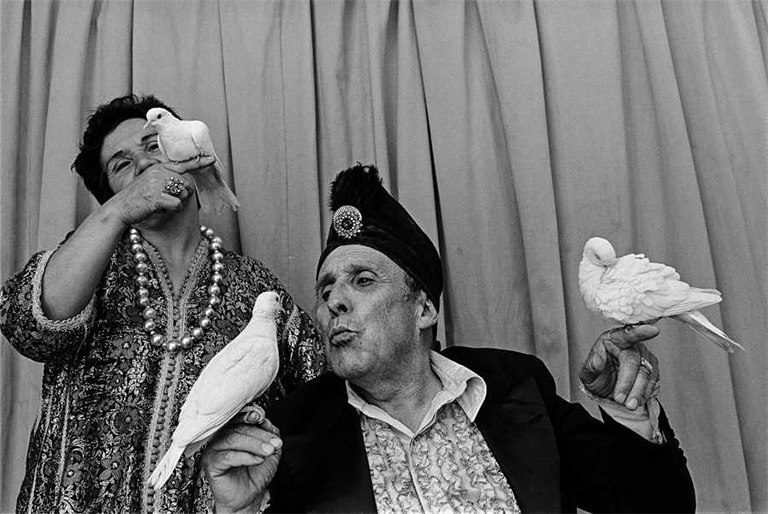
Paz Errázuriz
Mago Karman, Santiago, from the series The Circus, 1988
Fundación MAPFRE Collections
© Paz Errázuriz, courtesy of the artist
PAZ ERRÁZURIZ. FUNDACIÓN MAPFRE COLLECTIONS
–
Art Museum Miguel Urrutia, Bogotá
Curiosity. Transgression. Nonconformism.
Since she began her photography career in the 1960s, in the midst of the Pinochet dictatorship, Chilean photographer Paz Errázuriz has shown in her work a great curiosity for the human condition and for the underpriviledged of society: the mentally ill, the homeless, circus performers, transsexuals, prostitutes and indigenous natives. n her images of brothels, asylums, psychiatric hospitals, she captures the singularity of human behavior, breaking taboos.
This exhibition, composed of 171 photographies and 2 videos, aims to show the key series that make up the works of this artist, in which portraits become the best tool to showcase the most decadent and marginal face of Chilean society. The use of black and white intensifies the message of condemnation.
Bebe, Savignac de Miremont, 2011
Gelatin silver prints, contact
© Nicholas Nixon.
Fundación MAPFRE Collections.
NICHOLAS NIXON
– APR.
Tomie Ohtake Institute, Sao Paulo
Portraits. Feelings. Humanity.
Nicholas Nixon holds a unique and outstanding place in the history of photography in recent decades. His work, carried out with a very refined technique and a careful composition, takes us into his everyday reality. His closeness and humanity make the viewer participate and identify with the emotions that underlie his images.
Nixon has always worked on series in which he mentions fundamental aspects of human life, and one of them is the passing of time. Some of his works, such as The Brown Sisters or his family portraits can be found throughout his entire career. The way he works requires a great deal of time: the photographer establishes a relationship with the person being photographed generating an intimacy and trust that is reflected in his images.
Although his career is distinguished by and dedicated to portraits, Nixon also portrays spaces and objects, showing us themes he was attracted to with extraordinary clarity.