
Fundación MAPFRE Social Outreach Awards
100,000 Floors to Play On,
winner of the social impact award
What is Habitat for Humanity Dominican Republic?
Every family deserves a safe home in which they can build a better future. That is why a country’s housing deficit is not only measured by the lack of new construction, but also by the precarious conditions of many existing homes. According to organizations like UN-Habitat, ECLAC, and the IDB, the absence of basic services and adequate spaces represents an even more urgent problem than the shortage of new housing.
Habitat for Humanity is an organization that operates in 70 countries around the world with a single goal: to empower society through decent, safe housing.
One such country is the Dominican Republic where, since 1986, Habitat for Humanity has been building and improving homes for low-income families, supported by thousands of volunteers. Its project 100 mil Pisos para Jugar, or 100,000 Floors to Play On, in that country, has won the Award for the Project or Initiative with the Best Social Impact.
What is the 100,000 Floors to Play On project?
100,000 Floors to Play On is an initiative by Habitat for Humanity and the Inter-American Cement Federation (FICEM) to replace 100,000 dirt floors with concrete in vulnerable homes throughout Latin America and the Caribbean by 2028.
The initiative was christened 100,000 Floors to Play On, as replacing these dirt floors with cement is primarily intended to improve children’s lives: they are the ones who play, walk, and crawl on the dirt floors, which are a prime breeding ground for parasites, bacteria, and insects. Research has shown that replacing dirt floors with cement is not only beneficial for children’s health and hygiene, but can also impact their cognitive development.
Through this project, Habitat for Humanity in the Dominican Republic aims to replace 10,000 dirt floors with cement.
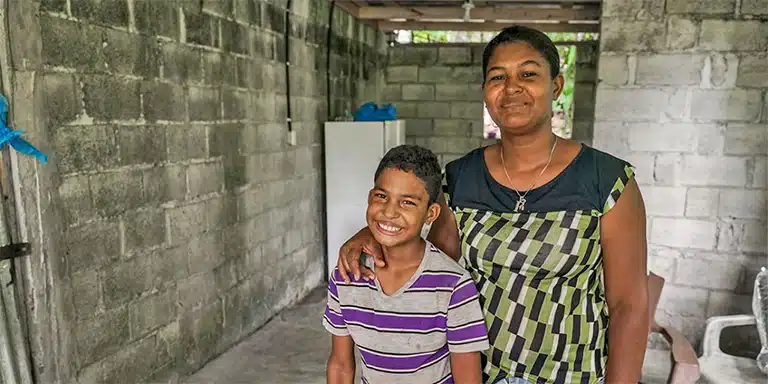
How does replacing dirt floors with cement make a difference?
This simple solution offers a number of significant improvements for families in a variety of areas:
- Replacing dirt floors with cement reduces parasitic infections, diarrhea, and anemia, especially in children. Freedom from these diseases improves their cognitive development. A cleaner and safer environment reduces school absenteeism due to illness. Children also spend more time playing indoors.
- In adults, it reduces stress and depression, as it leads to increased satisfaction.
- In economic terms, the families who benefit see their medical expenses reduced, which increases their financial stability.
- Replacing dirt floors with cement promotes employment in the community, as workers are needed to carry out this task.
Benefits for children’s health as a result of cement flooring
The main benefits of cement floors for children’s health are related to well-being and maintaining a safe environment in which children can develop.
In relation to health:
- Reduced risk of contracting Chagas disease.
- 70% fewer parasitic infections.
- Lower incidence of diarrhea (-49%).
- 81% fewer cases of childhood anemia.
- Fewer respiratory diseases and skin problems.
- Cognitive development in children improved from 36% to 96%.
- Improved mental health.
In terms of child safety, these floors are more durable and resistant, making them safer in the event of fire or flooding. In addition, they do not involve the use of toxic or flammable chemicals.
Another health benefit of cement floors for children is related to comfort and sustainability, as they create a better climate in the home by acting as a barrier against ground moisture.
The judging panel for the Award for the Project or Initiative with the Best Social Impact recognized the innovation involved in this new approach to improving the living conditions of the most vulnerable people, as upgrading their homes promotes equality, balance, and social inclusion—issues that are so necessary for thousands of families in the Dominican Republic.