Helen Levitt
FEB.19.2026 ──────── MAY.17.2026
Helen Levitt
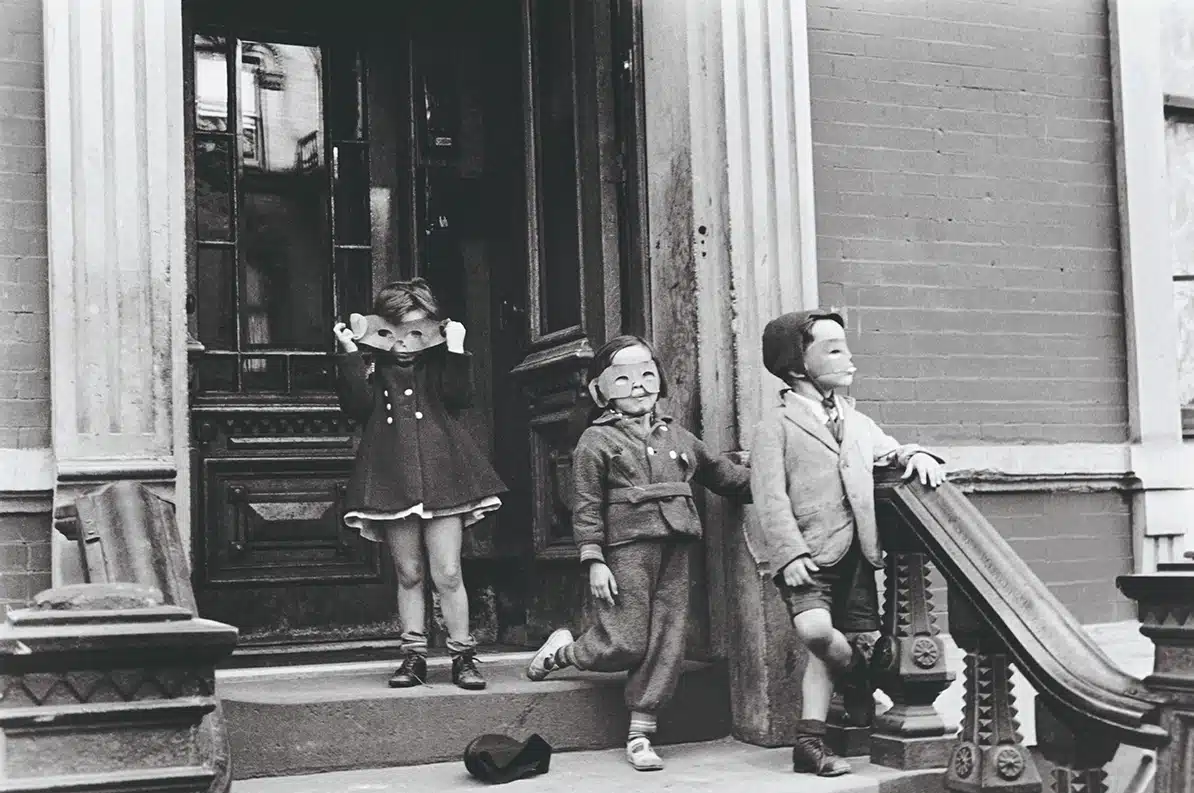
New York, c. 1940
© Film Documents LLC, courtesy Zander Galerie, Cologne
Helen Levitt (1913–2009) began photographing the streets of New York, her hometown, in the late 1930s, focusing mainly on poor neighborhoods such as Spanish Harlem or the Lower East Side, where the street is the main stage of daily life. Her camera was directed primarily toward children and their street games. These childhood scenes are the central theme of a body of work that captivates us with its ability to transform everyday situations into images that convey all that life can hold of emotion, mystery, or humor and that, although lacking an explicit narrative, manage to establish an immediate connection with the viewer. Levitt’s work soon received the recognition it deserved, and as early as 1943 the Museum of Modern Art in New York organized her first solo exhibition (Photographs of Children).
In later years, she became deeply interested in film and color photography. Regarding the former, in 1948 she collaborated on the documentary The Quiet One and co-directed In the Street, another documentary about the streets of Spanish Harlem. Both titles would be highly influential in the subsequent evolution of documentary cinema, inspiring artists such as Jonas Mekas and Andy Warhol. On the other hand, after receiving a Guggenheim Fellowship in 1959 to explore chromatic techniques, she began experimenting with color photography, a medium in which she would also develop pioneering work.
A socially committed artist, Levitt was one of the first women to forge a professional career in photography. This exhibition is the first to be organized based on the entirety of her work and archives, which have only recently been made available for public consultation.
Curator: Joshua Chuang